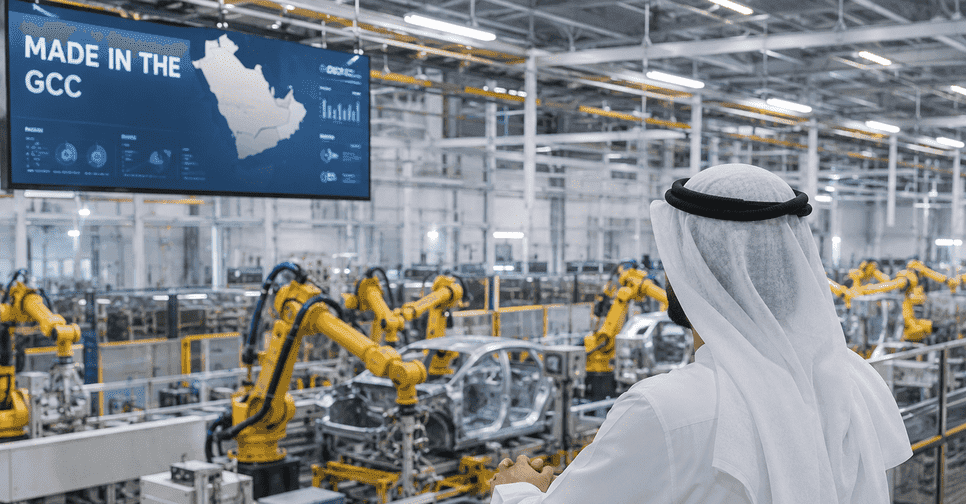
For years, the GCC has been associated with energy wealth, infrastructure scale, and capital strength. But the more important question now is this: can the region convert those advantages into a globally competitive manufacturing base? The answer is becoming increasingly difficult to ignore. According to the World Bank’s 2025 Gulf Economic Update, GCC growth is expected to reach 3.2% in 2025 and accelerate to 4.5% in 2026, supported by robust non-oil expansion and continued diversification efforts.
The GCC is Moving from Diversification to Industrial Execution
What makes the current moment different is that GCC industrialization is no longer just a policy aspiration; it is increasingly measurable. The GCC Statistical Centre reported that manufacturing remained the largest contributor within the non-oil economy, averaging 11.7% of GDP over the past five years.
These signals an important shift: the region is not only diversifying its revenue base, but also strengthening the sectors that create productive capacity, industrial jobs, and export potential. This means manufacturing in the Gulf is increasingly tied not only to diversification, but also to resilience, regional trade integration, and long-term competitiveness.
Can the GCC Turn its Industrial Ambition into Global Manufacturing Power?
What makes the current moment different is that GCC industrialization is no longer just a policy aspiration; it is increasingly measurable. For years, the Gulf Cooperation Council (GCC) has been seen as a region of capital, energy, and trade.
But a more pressing question is now emerging: can the GCC become a true global manufacturing hub? The answer increasingly appears to be yes. The World Bank’s 2025 Gulf Economic Update projects GCC growth at 3.2% in 2025 and 4.5% in 2026, driven by the continued expansion of non-oil sectors and renewed momentum in diversification.
At the same time, GCC-Stat’s 2024 Statistical Atlas, released in 2026, shows that GCC GDP reached around US$2.3 trillion in 2024, while merchandise trade totaled approximately US$1.6 trillion, underlining the region’s scale and its centrality to global trade flows.
The GCC Turning Industrial Ambition into Global Manufacturing Power
The Gulf has long been associated with capital, energy, and trade routes. But a more consequential question is now taking shape: Can the GCC become a serious global manufacturing hub?
The timing is right. The World Bank projects GCC growth to rise to 3.2% in 2025 and 4.5% in 2026, supported by the expected easing of oil production cuts and continued expansion in non-oil sectors. At the same time, the latest GCC Statistical Atlas 2024, released in 2026, shows the bloc reached approximately US$2.3 trillion in GDP in 2024, with merchandise trade around US$1.6 trillion, underlining the scale and connectivity already in place.
From Diversification Narrative to Industrial Reality
The GCC is no longer talking about diversification in abstract terms. It is building the physical, fiscal, and institutional conditions required for industrial growth.
Now manufacturing is no longer peripheral to the region’s economic agenda; it is becoming a measurable contributor to output, exports, and non-oil growth. The World Bank describe GCC economies as resilient, with non-hydrocarbon activity supported by reform momentum, domestic investment, and strong policy buffers.
AIM Congress a Strategic Interface
This is exactly where AIM Congress becomes relevant. Officially positioned as the world’s leading investment platform, AIM Congress 2026 is designed to convene global leaders, policymakers, investors, and innovators around sustainable investment, economic diversification, digital transformation, and international partnership.
Its official Global Markets pillar explicitly includes Global Manufacturing, alongside Foreign Direct Investment and Global Trade, making manufacturing a core part of its growth architecture rather than a secondary theme. AIM’s broader platform is built around the idea that sectors such as manufacturing only scale when capital, trade, policy, and technology are brought. Reinforces its role as a market-making platform for the industries shaping the next phase of global growth.
Advancing the GCC’s Next Industrial Chapter
Explore the opportunity, connect with the ecosystem, and join the dialogue shaping the future of manufacturing at AIM Congress 2026.